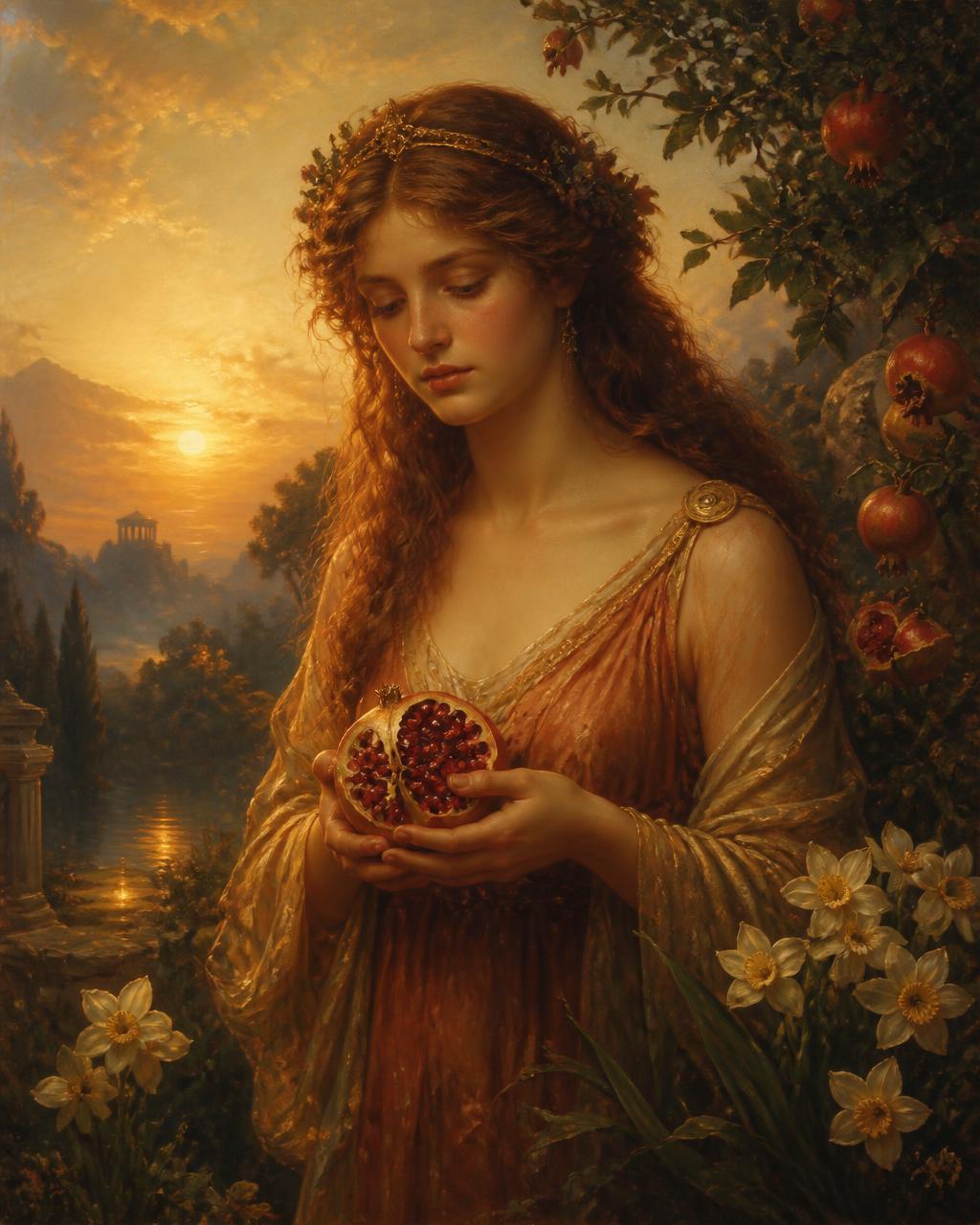
The myth of Persephone is one of the oldest stories Europe tells about change. On its surface it explains the seasons; beneath that, it describes what happens inside a human being when life is interrupted, and how something new is born out of that interruption.
The Myth
Persephone, daughter of Demeter, goddess of the harvest, was gathering flowers in a meadow when the earth opened and Hades, lord of the underworld, carried her down into his kingdom.
Demeter searched for her daughter across the whole world. In her grief she withheld her gifts: nothing grew, the fields went silent, and the earth entered its first winter.
At last Zeus intervened and ordered Persephone's return. But she had eaten pomegranate seeds in the underworld, and whoever tastes the food of the dead belongs, in part, to that world forever.
So a division was made: Persephone would spend part of the year below with Hades, and part above with her mother. Her return is spring; her descent is autumn. She is no longer only Kore, the maiden — she is Queen of the Underworld.
The Psychological Interpretation
In analytical psychology, the abduction is not primarily a crime committed by someone else. It is the image of an experience nearly everyone knows: a life is taken out of its innocence — by loss, illness, love, betrayal, or simply by growing up — and pulled into a darker, deeper layer of itself.
Kore — the unlived life
Before the descent, Persephone is:
- Innocent, but also undefined — a daughter, not yet a self.
- Living in her mother's world, protected and unformed.
- Beautiful and passive, gathering flowers on the surface of things.
The descent — the necessary wound
The underworld is the unconscious: everything we did not choose, and everything we cannot control. Jung believed that no genuine transformation happens on the surface. Something must go down, and something must be lost.
There is no coming to consciousness without pain.
Demeter — the grief that changes the world
Demeter's mourning is not weakness. Her refusal to let the world go on as before is what finally forces the gods to negotiate. Grief, honoured rather than hurried, has power: it insists that something real has happened.
The pomegranate seeds — you cannot return unchanged
The seeds are the most precise detail in the myth. Persephone does return — but she carries the underworld inside her. What we suffer becomes part of what we are. This is why she comes back not as the girl who left, but as a queen: someone with authority over the dark, because she has lived in it.
The Symbolic and Seasonal Reading
Persephone gives the year its emotional grammar. Autumn is descent — withdrawal, letting go, the turning inward of attention. Winter is the work done out of sight, in the root and the seed. Spring is not a reward but a return: the same soul, come back with knowledge.
- Descent: loss, initiation, the interruption of an old life.
- Dwelling: the slow, invisible work of the underworld.
- Return: renewal that carries the memory of the dark.
The myth insists on rhythm rather than cure. Persephone does not escape the underworld; she becomes able to move between worlds. That mobility — the capacity to descend and return, again and again — is the mark of a mature psyche.
The Maiden and the Queen
At the beginning of the myth, Persephone is simply the Maiden: innocent, protected, and still defined by her mother. After descending into the underworld she returns transformed. She is no longer merely Demeter's daughter — she has become Queen.
Unlike a hero who chooses adventure, Persephone does not volunteer. She is taken. This mirrors many experiences in life. No one chooses grief, depression, betrayal, trauma or profound loss; life sometimes carries us into psychological darkness before we are ready.
The person who emerges from suffering is not the same person who entered it. Wisdom is rarely inherited — it is earned.
The Underworld
In Jungian psychology, the underworld represents:
- the unconscious,
- repressed emotions,
- forgotten memories,
- instinct,
- the shadow,
- death and renewal.
The descent is not punishment. It is initiation. Without descending into the unconscious, genuine maturity cannot develop.
The Pomegranate
The pomegranate is one of the most powerful symbols in Greek mythology: it represents commitment to transformation. Once Persephone eats its seeds, she cannot return to her former innocence. Likewise, once we truly encounter grief, love, betrayal or profound self-knowledge, we cannot become who we once were. Some experiences permanently reshape us.
The Astrological Perspective
Persephone is often associated symbolically with themes found in Scorpio and Pluto. These correspond to:
- death and rebirth,
- psychological transformation,
- hidden power,
- shadow work,
- profound intimacy.
The yearly movement between the upper and lower worlds mirrors the cyclical nature of psychological life. No one remains permanently in spring; periods of inner winter are part of growth.
She did not come back from the dark. She came back with it, and it made her a queen.