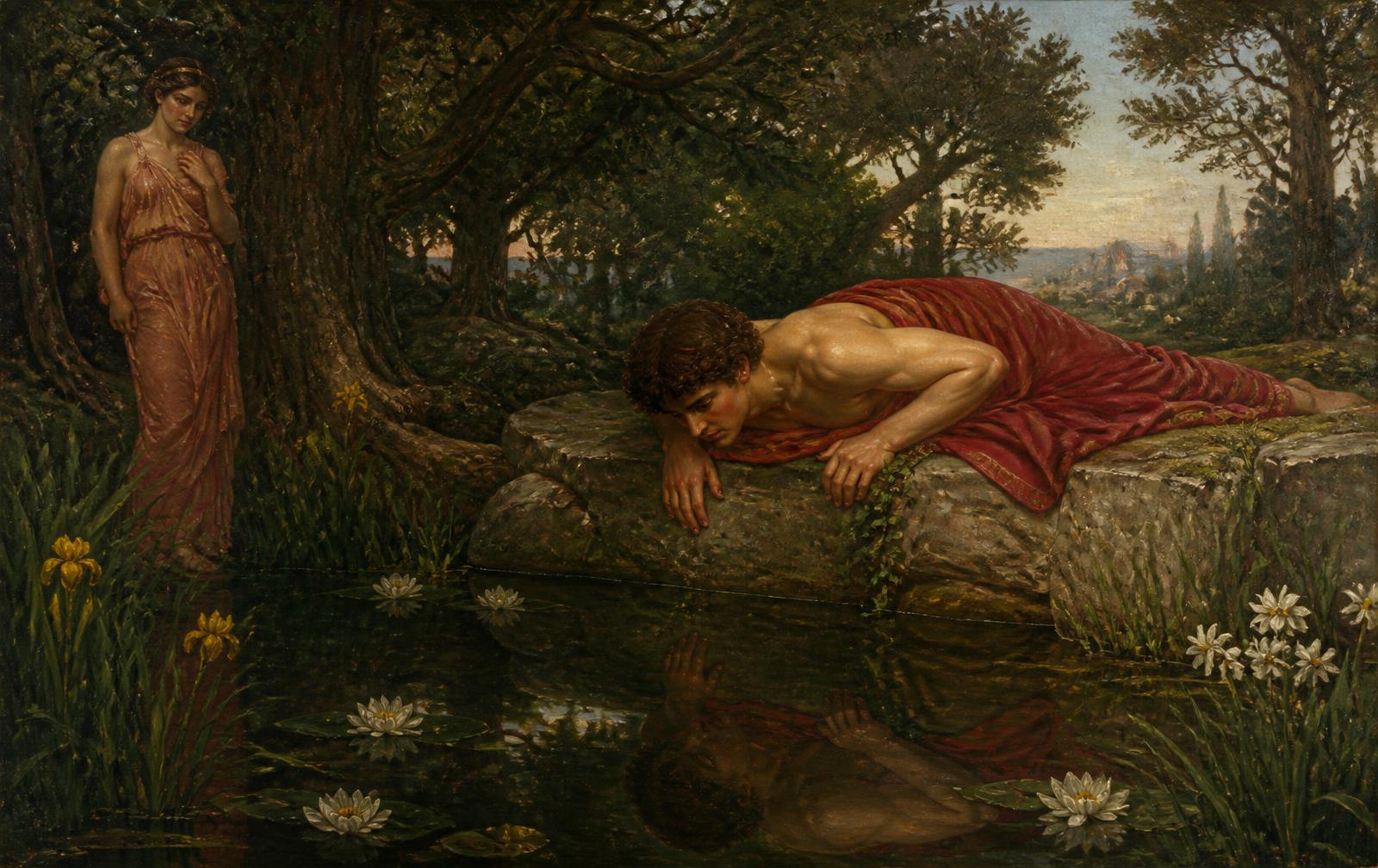
The myth of Narcissus is one of the most misunderstood stories in Greek mythology. In everyday language, the word narcissism has become synonymous with vanity and excessive self-love. Yet the ancient myth speaks of something far more profound.
From the perspectives of psychology, mythology and astrology, Narcissus is not a man who loves himself too much. He is a man who never truly comes to know himself.
The Myth
Narcissus was a youth of extraordinary beauty, the son of the river god Cephissus and the nymph Liriope. At his birth the seer Tiresias was asked whether the child would live a long life. His answer was strange: yes — if he never knows himself.
Narcissus grew up admired by everyone and moved by no one. Among those who loved him was the nymph Echo, who had been condemned to repeat only the last words spoken to her. She could not speak first; she could only answer. When she finally revealed herself, he turned away, and she faded until nothing remained but her voice.
As punishment, Narcissus was made to fall in love with his own reflection in a still pool. He reached for an image that could never reach back, and could not tear himself away. He died at the water's edge, and where he lay a white flower grew.
It is the goddess Nemesis who restores the balance. She leads him to a still forest spring where, for the first time, he sees his own face. Not knowing that the image is his own, he falls hopelessly in love with it. The more he reaches for it, the more it scatters. Unable to possess what he desires, he wastes away beside the water.
He shall live a long life, if he never comes to know himself.
The Psychological Interpretation
The prophecy is the key to the whole story. Narcissus is destroyed not by self-knowledge, but by its absence. What he meets in the water is not himself — it is an image of himself: flat, silent, without depth or history.
The reflection is not the self
What holds him at the pool is:
- A surface with no interior — beauty without a person behind it.
- An image that never contradicts him, never asks anything of him.
- A love that requires no risk, because it requires no other.
In depth psychology this is the persona mistaken for the soul. Narcissus falls in love with how he appears, and in doing so loses any way of discovering who he is. Genuine self-knowledge always includes the parts we would rather not see — the shadow. The pool shows him nothing of that.
He did not love himself. He loved a picture that could not disappoint him.
The mirror
The water represents the unconscious. The reflection represents the ego. Narcissus does not know his true nature; he knows only the beautiful image handed back to him. Psychologically, this describes a life lived through appearances — a person who begins to define themselves by:
- physical beauty
- social status
- professional success
- reputation and admiration
- the identity they project to the world
All of these are reflections. None of them are the Self.
The true meaning of narcissism
Modern language misunderstands narcissism as excessive self-love. In reality, beneath the grandiosity there is usually a fragile and unstable identity. The narcissistic personality constantly seeks admiration, validation, attention, recognition — because there is no stable inner sense of self. The reflection must be reinforced from outside; without admiration, the identity begins to collapse. The myth anticipated this psychological truth thousands of years before psychology gave it a name.
Tiresias' prophecy
The prophecy seems paradoxical, but it turns on two different meanings of self-knowledge. Narcissus never discovers his true Self; instead he mistakes his reflection for his identity, and that mistake destroys him. When we mistake the ego for our true nature, we lose contact with the soul.
The Jungian perspective
For Carl Gustav Jung the ego is necessary, but it is not the centre of the psyche. The true centre is the Self, which is larger than the ego: it includes consciousness and the unconscious, strength and weakness, light and shadow. Narcissus never reaches the Self. He remains imprisoned in the ego and never completes the process of individuation — enchanted, instead, by his own Persona.
The Persona
The Persona is the social mask, the face we present to the world. Everyone has one. The trouble begins when we believe the mask is who we are. Narcissus never sees beyond it; he mistakes appearance for essence. His tragedy is not vanity — it is confusion.
Echo — love that cannot speak first
Echo is the tragedy's other half. She can only repeat; she has no words of her own. Where Narcissus is a self without an other, Echo is an other without a self. Between them, no real meeting is possible — one cannot look away from the mirror, the other cannot say anything that is truly hers.
Many relationships fail in exactly this shape: one person needs a reflection, the other agrees to become one.
One has too much ego; the other has almost none. Both are forms of psychological imbalance.
Water as a symbol
In nearly every mythological tradition, water stands for the unconscious, the soul, emotion, the inner world. Narcissus gazes into the water — but instead of descending into its depths, he stays fascinated by its surface. This may be the central symbol of the entire myth: many people spend a lifetime looking at appearances and never discover the deeper waters of their own psyche.
The Flower
That a flower grows where Narcissus dies is not a decorative ending. The narcissus blooms early, bows its head toward the ground, and returns each spring. The image is one of transformation: the fixed, frozen self dissolves, and something living grows out of that dissolution.
The myth does not condemn beauty or self-regard. It warns against stopping at the surface — against mistaking the image for the depth it floats on.
Nature completes what the human being could not. The flower grows with its head gently bent toward the earth, as though still gazing into the water — but now there is no suffering in it, only beauty. Even our deepest illusions, the myth suggests, can eventually be transformed into something meaningful.
The Astrological Perspective
Symbolically, Narcissus belongs to the Leo–Aquarius axis, and to the relationship between the Sun and the Moon in reflection.
- Leo: the need to be seen, to shine, to be confirmed by the gaze of others.
- Aquarius: the corrective — belonging to something larger than one's own image.
- The Moon: the reflected light; we see the self only indirectly, never head-on.
- Neptune: the seduction of the ideal image, and the dissolution it brings.
The Sun does not see itself. It is known by what it illuminates. So too the self is discovered not in the mirror, but in relationship, in work, in the effect one has on the world.
Leo
Leo represents the building of identity and the desire to be seen. In its healthy expression it is authentic confidence and creative self-expression; in its immature expression it becomes dependent on admiration and applause. Narcissus is that shadow side — the confusion between genuine self-worth and the need to be admired.
Libra
Libra rules relationships and mirrors. We do discover ourselves through the eyes of others — but if we depend entirely on those reflections we lose our authentic centre. Libra asks: who are you when no one is looking?
Neptune
Neptune governs illusion, dreams, projection and enchantment. The reflection in the water is a Neptunian image: beautiful, captivating, and without substance. The more Narcissus reaches for it, the more impossible it becomes.
Pluto
Pluto asks the deepest question of all: who are you when every reflection disappears? When beauty fades, success ends, titles and status are gone, and no one is watching — what remains? That is the real question hidden inside the myth.
The Shared Symbolism
Together, Narcissus, Echo and the silent spring describe three dimensions of the psyche. Narcissus is the ego that mistakes image for identity. Echo is the loss of one's own voice through total identification with others. The spring is the unconscious — the place where truth can be found, but only by those willing to look beneath the surface.
This is not a myth about vanity. It is a myth about identity. The greatest danger is not loving ourselves too much; it is confusing our worth with the reflection the world gives back to us. In psychological terms it is a story about the ego; in Jungian terms, about the difference between the Persona and the Self; and in symbolic astrology, the timeless journey from illusion to authenticity — from the mirror of appearances to the discovery of the soul.
To know yourself, you must be willing to see more than your reflection.