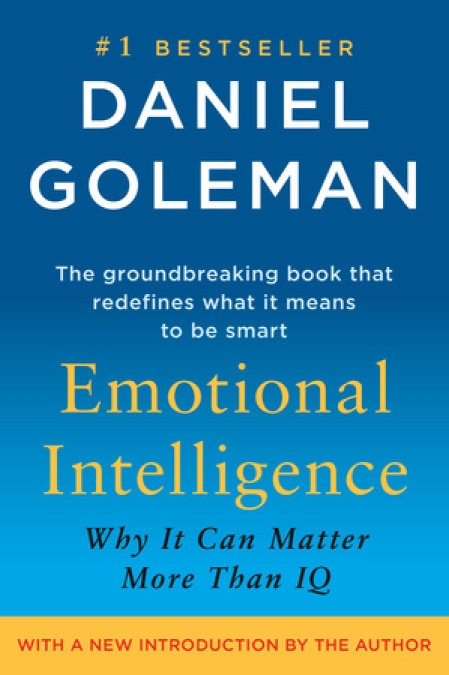
Published in 1995, Emotional Intelligence by psychologist and science journalist Daniel Goleman began with an uncomfortable observation: some of the most brilliant people he knew lived difficult lives, while others of quite ordinary intellect built warm marriages, loyal friendships and meaningful work.
Intelligence, it seemed, was not the whole story. Something else was quietly deciding how a life would go.
Goleman named that something emotional intelligence — the ability to recognise what we feel, to hold it without being ruled by it, to read the feelings of others and to move gracefully between the two.
IQ may open the door. What happens inside the room is decided by something older and softer.
The Two Minds
At the centre of the book is a beautifully simple image: we do not have one mind, but two. One thinks; the other feels. Most of the time they work together, like two hands on the same instrument.
But the emotional mind is faster. Goleman describes the amygdala — an almond-shaped structure deep in the brain — receiving danger signals a fraction of a second before the reasoning cortex has understood anything at all. In that gap, we say the sentence we regret, slam the door, go cold.
He calls it the amygdala hijack: the moment feeling takes the wheel and reason arrives too late, apologising.
The remedy is not to silence emotion. It is to widen the gap — to place a breath, a pause, a small interior clearing between the impulse and the act.
Between the feeling and the response there is a space. Freedom lives there.
The Five Domains
Goleman gathers emotional intelligence into five capacities — less a ladder than a garden, each one growing beside the others.
1. Self-Awareness — Knowing What Is Happening Inside
The first and quietest skill: being able to name what we feel while we are feeling it. Not afterwards, when the damage is done, but in the middle of it.
Much of our unhappiness is unnamed. Irritation that is really exhaustion. Anger that is really fear. Coldness that is really hurt. To name a feeling accurately is already to loosen its grip.
Self-awareness is not self-criticism. It is attention without punishment — the same patient gaze we might give a garden in early spring, noticing what is growing before deciding what to do about it.
2. Self-Regulation — Holding the Feeling Without Being Held by It
Regulation is often mistaken for repression. Goleman is careful here: the goal is not a life without storms, but the ability to stay standing inside them.
- Feeling anger without becoming cruel.
- Feeling fear without becoming small.
- Feeling desire without abandoning your own values.
Emotions are information, not instructions. The mature heart listens to them, and then chooses.
3. Motivation — The Fire That Does Not Need an Audience
Goleman describes an inner motivation that survives without reward: the ability to keep working, keep hoping, keep beginning again — often for years, often unseen.
He returns to the famous marshmallow experiment, in which four-year-olds were left alone with a sweet and the promise of a second one if they could wait. Those who waited were not simply more disciplined. They had learned to imagine a future vividly enough to make the present bearable.
Hope is not optimism. It is the refusal to stop trying.
4. Empathy — Reading the Language No One Speaks
Most of what people tell us is never said. It arrives in a pause, a shoulder, a change of voice, an answer given a half-second too quickly.
Empathy, for Goleman, is the ability to receive those signals — not to agree with everyone, not to dissolve into their moods, but to understand what it might feel like to stand where they stand.
It is the root of almost everything gentle in human life: forgiveness, good parenting, real friendship, ethical work. Cruelty, he notes, almost always requires empathy to be switched off first.
5. Social Skill — The Art of Being Together
The fifth capacity is the visible fruit of the other four: the ability to listen, to disagree without wounding, to repair after conflict, to make other people feel safe in your presence.
Goleman shows that in workplaces, in marriages, in classrooms, the people who hold groups together are rarely the cleverest in the room. They are the ones others feel calm beside.
Marriage, Work and Children
Some of the book's most moving pages leave the laboratory. Goleman looks at couples and finds that what corrodes love is rarely conflict itself, but contempt — criticism that attacks the person rather than the problem, and the slow withdrawal that follows.
He looks at children and argues that emotional literacy can be taught, like reading: naming feelings, waiting a turn, imagining another child's experience. Schools that teach it, he found, become measurably kinder places.
And he looks at work, where technical brilliance without self-awareness so often becomes a career that stalls, and where the ability to hear another person becomes, quietly, a form of leadership.
The Deeper Invitation
For all its neuroscience, Emotional Intelligence is an old-fashioned book about character. Goleman is describing, in modern language, what philosophers once called temperance, courage and compassion — the slow shaping of a person.
Its most hopeful claim is also its simplest: unlike IQ, emotional intelligence can be learned. At any age. After any history.
The brain, Goleman insists, keeps changing. So does the heart that lives in it.
To grow emotionally is not to feel less. It is to feel clearly, and to act with kindness anyway.
Perhaps this is why the book has never quite gone out of season. It does not promise success. It promises something rarer — the possibility of becoming someone others can rest beside.