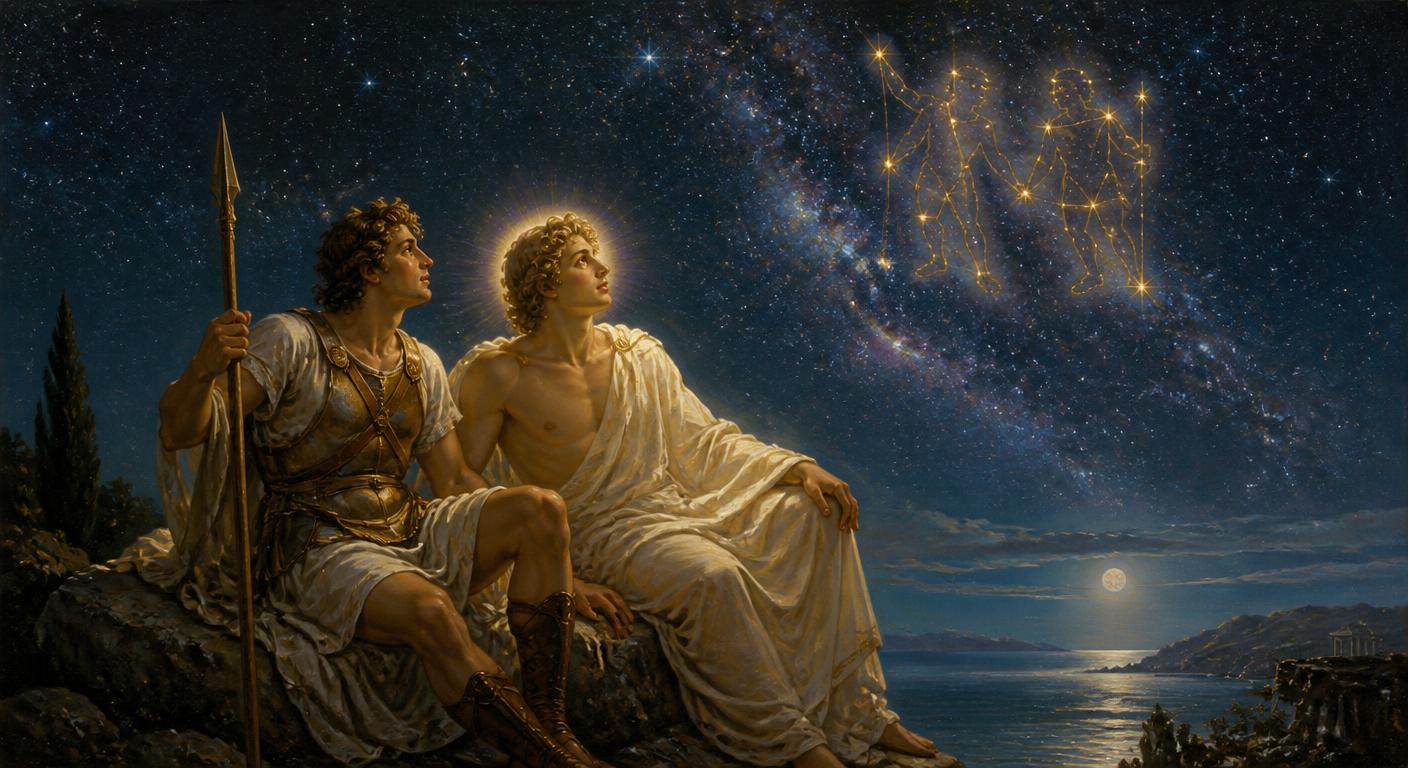
The myth of Castor and Pollux (Greek: Polydeuces) is one of the richest symbolic stories in Greek mythology. Beyond being an ancient legend, it can be understood as a profound map of the human psyche and as the archetypal foundation of the astrological sign Gemini.
The Myth
According to Greek mythology, the twins were born to Leda.
Castor was the son of Tyndareus, making him mortal.
Pollux (Polydeuces) was the son of Zeus, who had visited Leda in the form of a swan, making him immortal.
Although they had different fathers, they were inseparable.
- Castor became a legendary horseman and warrior.
- Pollux became the greatest boxer among heroes.
During a battle, Castor was killed. Unable to bear life without his brother, Pollux begged Zeus to let him share his immortality. Zeus granted his wish: the brothers would spend part of their existence on Mount Olympus and part in the Underworld, before finally being placed together in the sky as the constellation Gemini.
The Psychological Interpretation
From the perspective of analytical psychology — especially the work of Carl Gustav Jung — Castor and Pollux are not simply two brothers. They represent two dimensions of a single human psyche.
Castor — The Human Self
Castor symbolizes:
- the ego
- the physical body
- limitation
- mortality
- the everyday personality
He represents the part of us that lives within time, ages, suffers, fears loss, and identifies with worldly existence.
Pollux — The Higher Self
Pollux symbolizes:
- the spirit
- the immortal dimension of consciousness
- intuition
- inner wisdom
- the connection to the divine
He is the part of us that senses we are more than our history, achievements, or physical identity.
The Real Tragedy
The deepest meaning of the myth is not that Castor dies.
The tragedy is that the immortal part refuses to remain whole without the mortal part.
Psychologically, this suggests something profound:
Human wholeness cannot be achieved by rejecting our humanity.
We cannot become complete by trying to live only as “spiritual beings.”
Nor can we become complete by living only through the material world.
Wholeness requires both.
A Jungian Perspective
Jung described psychological development as the process of individuation — the integration of every aspect of the psyche into a unified Self. Castor and Pollux beautifully illustrate this process. Neither twin is complete without the other.
When we accept:
- our vulnerabilities,
- our mortality,
- our unconscious shadow,
- and our spiritual potential,
we begin the journey toward psychological integration.
The Astrological Interpretation
The myth forms the symbolic foundation of Gemini.
Popular astrology often reduces Gemini to the stereotype of having “two personalities.” The original myth suggests something much deeper: Gemini represents dual consciousness.
The Two Twins Within
Castor represents:
- logic
- language
- learning
- rational thought
- practical intelligence
Pollux represents:
- intuition
- inspiration
- symbolic thinking
- spiritual insight
- higher awareness
People with a strong Gemini influence often move naturally between:
- reason and intuition,
- facts and meaning,
- intellect and imagination,
- the earthly and the transcendent.
Their gift lies not in choosing one over the other, but in creating dialogue between them.
The Inner Dialogue
Gemini is not fundamentally about having two personalities.
It is about living with two complementary modes of awareness.
The inner questions become:
- What do I know?
- What do I feel?
- What does logic tell me?
- What does intuition whisper?
This is why Gemini is traditionally associated with communication — not only communication with others, but also the ongoing conversation within ourselves.
Castor’s Death as a Psychological Crisis
Nearly everyone experiences a moment in life when their inner “Castor” dies. This may take the form of:
- the loss of a loved one,
- divorce,
- serious illness,
- failure,
- burnout,
- or the collapse of a long-held identity.
The personality that once carried us through life is no longer sufficient.
At these moments, Pollux — the deeper Self — begins to emerge.
From a psychological perspective, the myth becomes a story of transformation rather than tragedy. The death of the old self creates space for a more integrated and authentic one.
The Symbolism of the Constellation
The brothers eventually become stars.
Stars have long symbolized orientation and guidance. Unlike the changing events of earthly life, they remain constant.
Psychologically, this suggests that once we reconcile the opposing forces within ourselves, we discover an inner point of stability — a guiding center that remains steady amid life’s uncertainties.
The Deeper Spiritual Message
The myth offers a timeless insight:
- Do not sacrifice your humanity in pursuit of spirituality.
- Do not sacrifice your spirit in pursuit of material success.
- True maturity comes from honoring both.
Castor and Pollux do not achieve immortality separately.
They become eternal because they refuse to be separated.
Their story reminds us that the deepest form of wisdom is not found in choosing between body and soul, reason and intuition, or mortality and transcendence. It is found in embracing all of them as inseparable parts of what it means to be fully human.
In this sense, the myth of Castor and Pollux is not merely about two legendary brothers — it is about the lifelong journey of integrating the mortal and immortal dimensions of ourselves into a single, whole being.